| |
|
|
| |
About Botanic Garden and Conservation Centre |
|
| |
 |
| Primate House |
The Old Calabar Botanic Garden was established in SE
Nigeria by the Royal Botanic Gardens, Kew in 1893. The Cross River State
Forestry Department converted the garden into a zoo in the 1970s for a
brief spell.
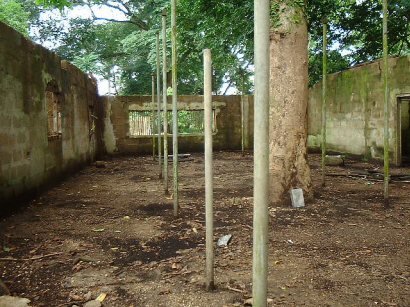
The ground have been derelict for the last 20 years. Over the
last 10 years the Forestry Commission and NGOs in Calabar have discussed
various ideas to rehabilitate the garden.
In 1999 the governor of Cross River State proposed
rehabilitation of the garden in collaboration with local NGOs. The
Forestry Commission set up a garden Committee including the Iroko
Foundation, Cercopan and some other local NGOs who drew up a proposal.
This resulted in the Headley Trust supporting a one-week
workshop to design a new master plan (landscape design) for the gardens
with participation from all these local partners, the Royal Botanic
Gardens, Kew and the Limbe Botanic Gardens, Cameroon.
The design workshop was held in July 2001 and a three-year
plan to redevelop the gardens has been drawn up. Funds are now required
to implement the new landscape design.
Source: Official web of
the Project (2009)
 |
| Hyena house (source: official web of
the
Project of new Botanic Garden and Conservation Centre) |
The Iroko Foundation (based in the UK) and Cercopan,
a Nigerian NGO, have commenced a project to rehabilitate the old
botanical gardens in the centre of the city of Calabar in SE Nigeria.
The new garden will incorporate a nature trail, medicinal plant nursery,
primate rehabilitation facilities and an environmental education centre
and will educate Nigerians about the endangered African rainforests of
Cross River State.
The botanical gardens were established by the British
colonial administration in the mid-1880's to introduce economic crops
into Nigeria from other parts of the tropics and to cultivate African
plants for export to other parts of the empire. However, by the 1930s
much of the grounds were sold off leaving the remainder to house the
state government Forestry Commission offices. The Commission
unsuccessfully tried to establish a zoo in the garden and the grounds
have been derelict for over two decades. In spite of this, they are
still visited by people who sit in the shade of its large old trees
since the area is the only green space close to the university and the
commercial centre of Calabar city. Many of these trees are indigenous to
the rainforests of Cross River State and are endangered by the logging
industry in the area.
In 2001, staff from the Iroko Foundation, Schoenaich Rees
Landscape Architects, the Royal Botanic Gardens, Kew and Limbe Botanic
Garden (in neighbouring Cameroon) facilitated a workshop with the Cross
River State Forestry Commission, and local NGOs to re-design the garden.
The new design entails substantial re-landscaping of the grounds and
will be planted with endangered economic and medicinal plants collected
from the Cross River rainforests. A nature trail will be constructed
through these plantings together with facilities for the rehabilitation
of orphaned captive primates that will be re-introduced to the wild. The
garden will also contain a nursery to propagate and sell medicinal
plants and trees from the rainforests to the public. This nursery will
operate an extension service to train villages throughout the state, to
establish their own tree nurseries. The design also incorporates an
environmental education centre for schools, university students, and the
public.
Cercopan is running the gardens with the Forestry Commission
on behalf of a semi-autonomous management board. The garden staff will
be Nigerians who will be trained at Kew and Limbe Botanic Garden. There
are plans to establish a trust fund for the gardens’ long-term up-keep.
The project is still in its very early stages and has raised
an initial amount of funding to kick off the work. It has recruited a
small number of staff to commence the re-landscaping and replanting of
the garden. We are seeking extra funds particularly for the landscaping
and for training the new staff of the garden at Kew. It is hoped that
once the staff of the garden have been recruited, the garden will join
the newly established African Botanic Garden Network.
Source: site in the web of
BGCI (2009)
 |
| Giraffe house (source: official web of
the
Project of new Botanic Garden and Conservation Centre) |
 |
| Lion House (source: official web of
the
Project of new Botanic Garden and Conservation Centre) |
 |
| Giraffe house (source: official web of
the
Project of new Botanic Garden and Conservation Centre) |
 |
| Camel enclosure (source: official web of
the
Project of new Botanic Garden and Conservation Centre) |
|
|
|
|
|