| |
 |
| The first entrance to the zoo
(1864) |
The Moscow Zoological Park has come a long way from a small zoological
garden to the large scientific, educational and conservation institution
of today.
The Moscow Zoological
garden was founded by the All-Russia Emperor Society for Acclimatization
of Plants and Animals in the middle of XIX century; it was opened for
visitors on 13 of February 1964. Anatoly P. Bogdanov, Professor of the
Moscow State University was one of the founders and organizers of the
Zoological garden.
The foundation of
the Zoological garden was very important for the cultural life of Moscow
since it was the first attempt to establish a scientific institution of
such a sort – "a living museum outdoors" as Professor Bogdanov said.
Besides, for those days it was a unique experiment aimed at the creation
of the zoo in quite severe climatic conditions, as it was in central
Russia. The members of the All-Russia Emperor Society believed that the
primary goals and purposes of the Zoological garden were the following:
- Collecting alive specimens of higher vertebrates ( firstly – the
animals of Russian fauna) for scientific observations;
- Establishing the collection of typical animals that could serve
educational purposes, i.e. distribution of zoological knowledge among
the wide public communities;
- Carrying out scientific experiments and observations of important
animals, especially of the domestic animals of Russian breeds.
The Zoological garden was
financed by the entrance fees and sponsored by private donations,
including contributions by the Emperor's family. In the first years
people were glad to visit the Zoological garden, th e annual number of
visitors coming up to ten thousands. People could see a significant
collection of animals that numbered in 1864-1865 134 specimens of
domestic animals and 160 specimens of the wild animals.
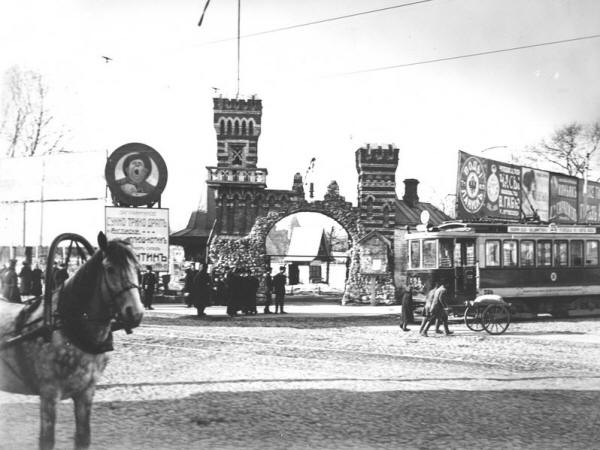 |
| The zoo entrance (1920s) |
However, the
incomes did not cover the expenses of the Zoological garden, which was
facing serious problems with lack of money needed for acquiring and
management of animals, repair of old building and construction of new
facilities, cages and enclosures. Since the City Government refused to
give support to the Zoological garden, the Society had to grant a lease
to a private company – the Ryabinins' family. For the three years of
running the Zoological garden the Ryabinins' family had brought it to
ruin, having transformed it into merely an entertainment establishment.
In 1878 the Zoological garden was returned at the disposal of the
Society for Acclimatization of Plants and Animals, and fund raising
activity started again. The Society managed to revive the activity of
the Zoological garden for a while, and even to buy a number of animals,
but in 1905 it found itself in the very centre of the major revolution
battles. It was badly damaged: the buildings were ruined, the library
was set on fire, many animals perished. Again, the Society was forced to
turn the Zoological garden over to private owners.
Following the
October Revolution of 1917 the Society ceased to exist, and in 1919 the
Zoological garden was nationalized. In 1922 it was transferred to the
authority of Moscow City Council and since then it has been supported by
the City Authorities. The Zoological garden territory was almost
doubled.
In 1926 the
Zoological garden was renamed "Zoological park". At that time the sphere
of the zoo activities extended, the animal collection increased in the
numbers, new departments were established, such as scientific research
and educational units, scientific veterinary, biological and nutrition
laboratories; the Moscow zoo Circle of young biologists was also
founded. New exhibits, quite modern for those days, were established on
the recently joined "New" territory. People could stroll along the
walkways in the spacious enclosures amongst fallow and sika deer. One of
the most interesting exhibits of the Zoo had an exotic name "Animal
Island". It was a high stony rock surrounded by a deep water ditch that
separated the visitors from bears, tigers, lions and other larrge beasts
of prey which were inhabiting the "Island".
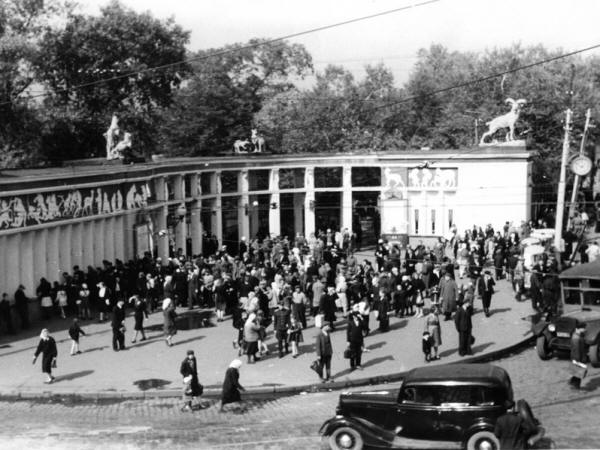 |
| The Zoo entrance (1947) |
The Zoo functioned even
during the years of the Second World War. More than six million people
visited the Zoo from 1941 to 1945. During that period a Zoocomplex,
industrial enterprise, and the Durov Animal Theater were a part of the
Zoo. After the end of the War these organizations had separated from the
Zoo and became independent. In the late 60-s the Zoo was transferred to
the authority of the central administrative board of culture. The number
of zoo animals had grown up to 3.5 thousand specimens of 500 species and
subspecies.
The Moscow zoo was
becoming one of the larger scientific and educational institutions of
Moscow and the favorite recreational place for the habitants of Moscow
and city visitors.
The zoo staff
carried out many forms of educational activities with the purpose to
distribute knowledge in the field of natural history and to promote an
increase in public awareness of the necessity for wildlife conservation.
The zoo assisted the schoolchildren and students with studying biology,
actively participated in scientific research, and contributed in the
periodicals and scientific publications.
In 1970-90-s the
Moscow zoo took an active part in international wildlife conservation
activities having become the member of many European and International
Breeding Programs under which it exchanged its rare and endangered
animals, shared experience and information. The zoo specialists attend
international conferences and meetings and exchange visits with their
foreign friends.
The Moscow zoo was very successful in the conservation of endangered
species of animals, but by the end of 80-s the zoo's condition became a
cause of alarm as the facilities, enclosures, and technical equipment
were deteriorating with time. The necessity for urgent measures needed
to improve the management of the animals was evident. A history of the
development of the project of the reconstruction of the oldest zoo in
Russia is quite long and complicated, as the first plans of the
reconstruction have been worked out as long ago as in the 1970-s.
Unfortunately, due to the economical and social problem most part of the
ideas and intentions never became a reality. Truth, a partial
reconstruction of the main entrance, Monkey house, "Animal baby
background" and Lion house had been accomplished in that period, but for
many years the dreams about the foundation of a new zoo in another
region of Moscow has been remaining just "castles in the air", as well
as the projects of the general reconstruction of the zoo.
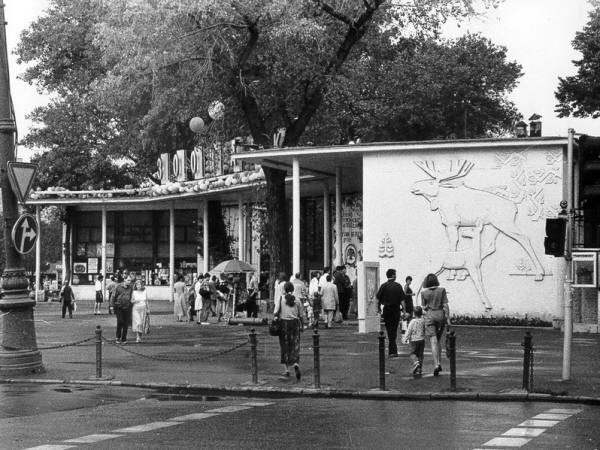 |
| The zoo entrance (1994) |
At last, in the beginning
of 90-s the new government of Moscow headed by the City Mayor Yuri M.
Luzhkov made a decision to start a general reconstruction of the Moscow
zoo, and the total reconstruction has finally started in 1990. According
to the timetable of the project, the first stage of the reconstruction
is to be completed by 1997, to the 850-th Anniversary of the City. The
team of architects developing the reconstruction project was headed by
Anatoly A. Andreev who has been involved in the zoo design and
architecture since the 1970-s. The main principles that were assumed as
a basis of the project were the following:
- preservation or partial reconstruction of the historically valuable
buildings and water pools;
- arranging additional insulation for the protection of animals and
visitors from the noise of city streets;
- expansion of the old zoo territory due to the joining of adjacent
sites and buildings;
The architects and builders have succeeded in achieving their aims.
Almost 4 additional hectares of space has been joined to the former 16.8
hectares. With some minor exceptions all important zoo constructions
have been preserved, including the ones that actually were dilapidated.
The building of the first new facilities was completed in 1993, those
were: the passage bridge with the adjacent enclosures for Japanese
Macaques, Pinnipeds, raccoons and birds; an enclosure for large birds of
prey; and a complex of enclosures for smaller and middle cats (Leopards,
Pallas cats, Lynx). The passage bridge has connected two territories of
the zoo ("Old" and "New") which allows visitors to avoid crossing B.
Gruzinskaya street with its heavy traffic. The birds of prey exhibit,
built on the side of a large pond, consists of a few enclosures covered
with net and placed around an artificial 10-meter high rock. Moving the
birds of prey may cause a lot of problems but some of the Eagles at the
zoo have already started to breed in their new enclosures.
 |
| The zoo entrance now |
Following the
mentioned facilities the reconstruction of one of the most remarkable
expositions of the Moscow zoo – "Animal Island" – was carried out. The
architects were able to preserve this wonderful construction in its
historic appearance where the animals are being kept in the environment
that is very similar to their natural habitats; Amur tigers, Striped
hyenas, African wild dogs and Asian black bears are doing well and even
started breeding on the "Island". This summer a pair of Asian lions
arrived to the "Animal Island" under the EEP Breeding Program; the male
was born in Helsinki Zoo, and the female originates from Chester Zoo in
UK. The second floor of the rock is occupied by the exposition of "Exotarium"
with small sea water aquariums.
In 1994-95 many more zoo
facilities were reconstructed: the large pond for waterfowl and
flamingo, Przewalski's horse and antelope expositions, enclosures for
Spectacled bears and Cheetahs, "Tur hill" for mountain ungulates, and
"Polar World" housed Polar bears and other polar animals.
In 1994 two large buildings were put into operation – administration
office and research and veterinary complex, and also the islands for
Gibbons were constructed on the small pond.
New enclosures have been built near the main entrance: Wallabies and
Emus feel quite comfortable in their "Australian" exhibit, and Capybaras
living in the "South America" expositions have already given their first
offspring. In 1996 the main entrance itself with a small waterfall and
"speaking" clock was constructed. The building of the Bird World and
enclosures and pool for penguins was also completed in 1996. In the same
period of time the old dilapidated Elephant House was torn down in order
to allow the building of a new Elephant facility in its place. Four
African and four Asian elephants (including 1-year old Asian elephant
baby) were moved into another facility for their temporary holding,
which was a completely renovated building of the former tram station.
This facility is not opened to the public but it is hoped that the
visitors will be able to look at the Elephants at their new Elephant
House in 1997 or 1998.
The new "Children Zoo"
was opened on the "Second" territory of the zoo where the children can
see the live characters of their favorite fairy tales surrounded with
wonderful sculptures, and enjoy riding small ponies.
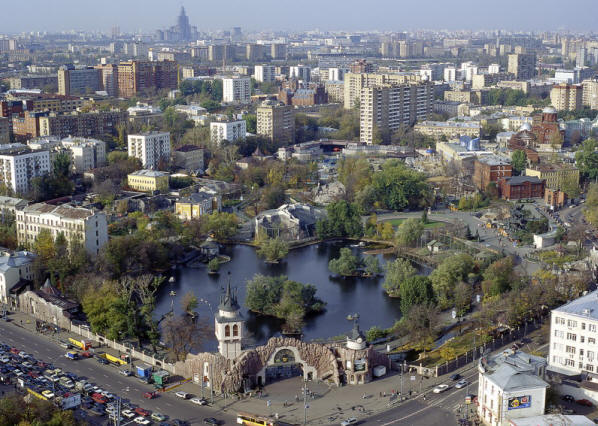 |
| General view of the zoo |
Over 50
facilities have been reconstructed and built during the whole period of
reconstruction. This large-scale process became possible only due to the
support of the Moscow Government and the City Mayor Mr. Luzhkov.
In 1996 about 200
hectares of ground in 100 kilometers from Moscow (near Volokolamsk city)
were given to the Moscow zoo for the establishing a Breeding Station for
rare and endangered species of animals. The natural landscape of the
territory with woods, hills and water reservoirs in combination with
ecological pureness of the region create the most beneficial conditions
for the establishing a large conservation center. The enclosures for
cranes, birds of prey, cheetahs and leopards are already constructed and
are now inhabited by some of zoo animals.
The general
reconstruction of the Moscow zoo represents a unique event when the
renovation and reconstruction of almost all the zoo facilities was
completed within a so short period of time. In these difficult
circumstances the staff of the Moscow zoo did everything possible in
order to save the valuable collection of the zoo animals. We are glag
that the Moscow zoo have been totally renovated by the 850-th
Anniversary of Moscow and now the visitors have an opportunity to see
one of the most interesting animal collections in the world at the
"rejuvenated" Moscow zoo.
Source (including the pictures): official site of the
Mocsow Zoo
(2013, author of the text: V. V. Spitsin)
|
|